




The best all-weather portfolio is the one that never lets a single bad quarter wreck your plan.
2026 has already delivered sticky inflation prints, whiplash rate expectations, and digital-asset swings sharp enough to gut a single-asset portfolio twice over.
Investors who thought they were diversified still got hit hard when everything they held moved together at once.
That's exactly what happened this year.
Investors who thought a plain stock and bond mix counted as diversification watched both legs sell off together during the rate whiplash in the first half of 2026.
Digital-asset holders who assumed spreading across a handful of different tokens was protection found out correlation doesn't care about ticker symbols, when the market turns risk off, it turns off everywhere at once.
A portfolio that only looks diversified on paper still gets wrecked in real time.
What Is an All-Weather Portfolio (and Why It Matters in 2026)
An all-weather portfolio is what's missing from most of these stories, because most investors don't blow up a portfolio in one bad quarter.
They blow it up slowly, by chasing whatever just worked, an equity rally, a stablecoin yield, a token that tripled, and holding on too long once that trade runs out of road.
Then they rotate into whatever worked last, right as it stops working, and start the cycle over from a worse position than before.
Without a structure built to already cover whatever comes next, every decision turns into a bet on being right about the next shift, and nobody bats a thousand 2 cycles in a row.
The investors who come through each turn the least shaken usually aren't the ones who guessed correctly, they're the ones who built something that never needed the guess to be right in the first place.
The Classic All-Weather Portfolio Model
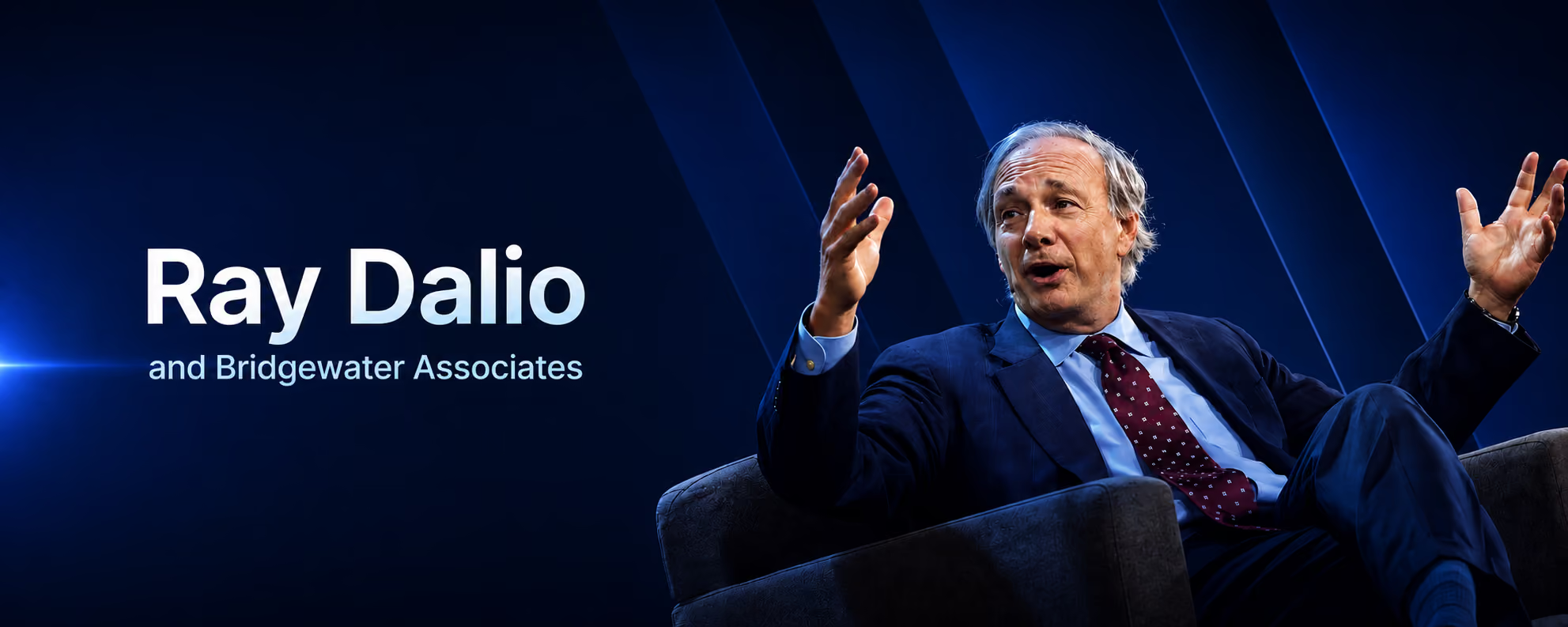
The original all-weather portfolio came from Ray Dalio and Bridgewater Associates. The classic version breaks down like this:
- 30% U.S. equities
- 55% Treasury bonds, split across long and intermediate durations
- 7.5% gold
- 7.5% diversified commodities
The logic? Equities do well in growth periods, long bonds do well in disinflation or recession, and gold and commodities protect against inflation shocks.
In March 2025, State Street and Bridgewater made this strategy available in a single retail product, the SPDR Bridgewater All Weather ETF (ticker ALLW). Its numbers so far:
- 0.85% expense ratio, actively managed
- 3.93% year to date (as of July 2026)
- 5.30% annualized over the last ten years
- 1.61 Sharpe ratio
That is a lower return than the S&P 500 over the same stretch, but with roughly half the volatility and much shallower drawdowns, which is the entire point of the approach.
What Makes the Best All-Weather Portfolio in 2026

The best all-weather portfolio for today's market does not just copy the 1996 Dalio blueprint.
It adapts the same principle, balance across growth, inflation, and rate environments, to a world with higher structural rates, deeper private markets access, and a maturing digital-asset class.
A few adjustments worth considering:
- Rate sensitivity. With rates higher than the environment the classic model was built for, some investors shorten bond duration slightly or add inflation-protected securities alongside long Treasuries.
- Private markets. Where accessible, a small sleeve of private credit or private equity can add a return stream that does not move in lockstep with public markets.
- Digital assets as a satellite, not the core. A modest allocation to digital assets (commonly in the single digits to low teens as a percentage of the portfolio) can add an uncorrelated growth sleeve, but it should sit alongside the all-weather core, not replace it.
The best all-weather portfolio is the one that fits your own time horizon and risk tolerance while keeping every major economic outcome covered. There is no single fixed formula that is right for everyone.
How This Fits Decentralized Master's ABN Framework
DM's core framework, ABN, maps directly onto the structure above. Here is how each piece fits.
A: All Weather Portfolio
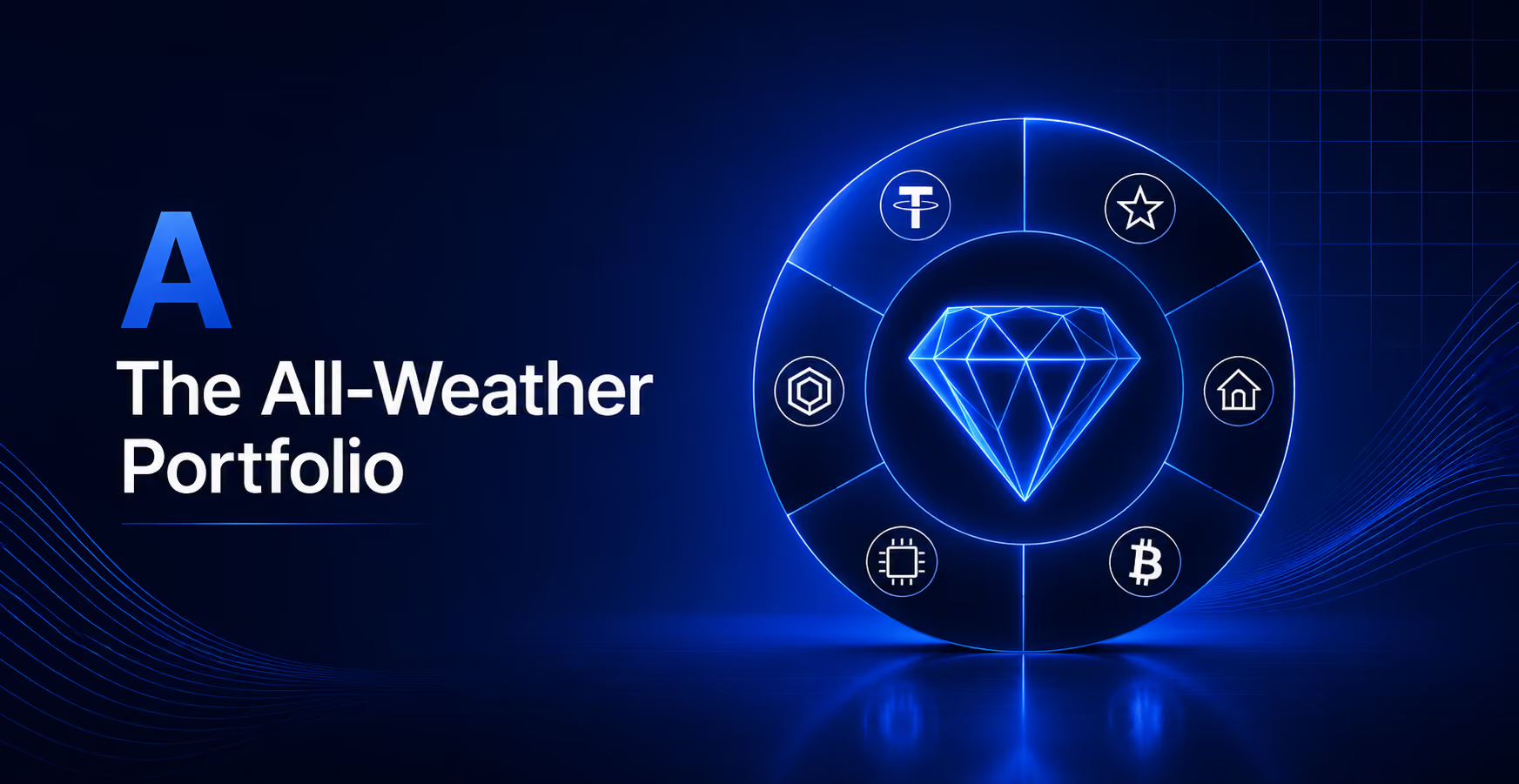
The All-Weather Portfolio (Phase A) is the foundation of Decentralized Master's ABN framework: a diversified base built to hold up across growth, recession, inflation, and deflation, without betting on which one comes next.
It spreads across 6 categories, including digital gold, blue-chip digital assets, tokenized equities, tokenized fixed income, tokenized real estate, and a smaller growth allocation, so no single category can sink the whole portfolio.
Members build this layer first, guided by a one-on-one mentor and backed by a 35-plus person research team, before adding anything more active on top of it.
B: Becoming the Bank

Become the Bank (Phase B) is DM's yield layer, built directly on top of the Phase A foundation.
Instead of letting capital sit idle, it routes assets through 2 parallel strategies: a lower-volatility stablecoin yield strategy for capital preservation, and a higher-yield, higher-volatility blue-chip digital-asset strategy for growth.
Both generate income from real on-chain activity, lending, liquidity provision, and staking, rather than a bank intermediary keeping the spread for itself.
Yield isn't guaranteed and carries protocol and counterparty risk, so DM's research team screens providers for track record, audits, and liquidity before recommending them to members.
Want a lower-commitment way to see this in action first?
We run the Beat Banks newsletter as the entry point for Phase B: each week it breaks down which yield protocols are worth using, which rates are real, and which to avoid. Subscribe to Beat Banks
N: Native Market Access

Native Markets (Phase N) is the final phase, focused on early-stage digital-asset opportunities before they reach mainstream exchanges.
Instead of waiting for an asset to get listed, discovered through social buzz, or passed along by a friend, all of which happen well after the largest gains are already gone, Phase N positions members to access assets while they're still trading in their native, pre-listing markets.
Position sizing is strict: no more than 10% of portfolio capital to any single position, a cap on liquidity-pool exposure, and a maximum of ten active positions at a time, so no single pick can do lasting damage.
Most early-stage assets don't succeed, and Phase N is built around that reality rather than against it: DM's research team vets opportunities before members ever see them, and every position is funded from Phase B yield rather than principal, so a loss there costs income already earned, not savings already invested.
Want a preview of this phase before committing?
We uncover the gems every week, early-stage opportunities vetted by our research team before they reach exchanges like Coinbase, and send them straight to your inbox. Get the Weekly Picks from Gems Uncovered
Best All-Weather Portfolio vs. Golden Butterfly Portfolio

A common alternative to the Dalio model is the Golden Butterfly Portfolio, derived from the older Permanent Portfolio concept.
It typically splits assets into 5 equal 20% slices: U.S. total stock market, small-cap value stocks, long-term Treasury bonds, short-term Treasury bonds, and gold.
Compared with the classic all-weather model, the Golden Butterfly leans more heavily into equities and gold and less into long bonds, which has historically given it a slight edge in total return with a similar risk profile in some comparisons.
Neither version is objectively "best" in isolation; the right choice depends on how much equity volatility you are willing to tolerate for extra long-run return.
Common Mistakes Investors Make With All-Weather Portfolios
- Treating "all-weather" as "risk-free." The strategy reduces volatility, it does not eliminate the possibility of loss.
- Skipping rebalancing. Letting winners run without trimming back to target weights quietly turns an all-weather portfolio into a concentrated bet.
- Over-allocating to a single satellite. A digital-asset or private-market sleeve that grows past its intended size can turn a defensive structure into a speculative one without the investor noticing.
- Copying the model without adjusting for personal time horizon. A 30 year old and a 65 year old should not run the identical mix.
Ray Dalio built the all-weather portfolio to survive whatever the economy throws at it. DM's ABN framework takes that same principle and applies it across digital assets, from the foundation in Phase A to the yield layer in Phase B to the early-stage access in Phase N. Our experience and 35-plus person research team back every call we make, that's the receipt.
It's the same structure our mentors use with members every day.
Want help building yours? Book a free call with a DM mentor and we'll walk through where your portfolio stands today.
FAQ
Is the all-weather portfolio still good in 2026?
Yes, as a risk-management framework. Returns have trailed the S&P 500 over the last ten years, but with roughly half the volatility, which is the tradeoff the strategy is designed to make.
What percentage should go to gold?
The classic Dalio model uses 7.5%. Variants like the Golden Butterfly use 20%. There is no universal number; it depends on how much inflation protection you want relative to growth exposure.
Can digital assets fit in an all-weather portfolio?
Yes, as a small satellite allocation layered on top of the core, not as a replacement for the bond, equity, and hard-asset base that makes the strategy work.
This article is for educational purposes only. Nothing here should be considered investing, legal, or tax advice. All investing involves risk, including the potential loss of principal.
Sources: