




The best investment mentorship programs all pass one test: someone specific knows what you are working on, and will notice if you get it wrong.
Type the phrase “best investment mentorship programs” into Google, and you get day trading bootcamps, prop-firm pipelines, and wealth managers who will run your money for you.
What you rarely find is what many investors actually want: a knowledgeable person who meets with you regularly, looks at the decisions you are actually making, and teaches you to make better ones across your whole portfolio.
This guide is for the investor who already has capital deployed and wants to build genuine capability rather than outsource it.
We set out the criteria first, then apply them.
What separates a real investment mentorship from a course

The word "mentorship" is attached to four very different products, and the differences matter more than the marketing suggests.
- A course is one-directional. You receive content, you self-serve, and nobody notices whether you finish. Courses are efficient for foundational knowledge and useless for accountability.
- A community gives you peers. Discussion, shared research, and the reassurance that other people are working through the same problems. Valuable, but no one in a community is responsible for your progress.
- An advisory relationship puts a professional in charge of your capital. That is a legitimate service, and for many people it is the right answer. It is not education. The investor who uses an advisor for 20 years usually ends that period no more capable than when they started.
- A mentorship is the only one of the four that transfers capability. A named person, recurring contact, and review of your real decisions rather than hypothetical ones.
The test is simple: does someone specific know what you are working on, and will they notice if you get it wrong?
How we evaluated each best investment mentorship program

Stating criteria before naming any provider keeps a roundup honest.
Here are the 6 tests we applied:
Asset class breadth.
• Does the program cover macro conditions, public equities, private markets, and digital assets, or does it teach one silo and leave you to connect the rest yourself?
• Portfolios are multi-asset. Education often is not.
Mentor access.
• Is there genuine one-on-one contact with a named person, or are group webinars being described as mentorship?
Curriculum structure.
• A sequenced path that builds, or an unordered content library you are left to navigate alone.
Mentor credentials.
• A verifiable professional background, not a screenshot of a trading account.
Time horizon fit.
• Built for long-term portfolio construction, or for intraday speculation? These require almost opposite temperaments.
Ongoing versus time-boxed.
• Does support continue after the initial term, or does the relationship end when the certificate is issued?
Best investment mentorship program picks for 2026
6 options, each suited to a different investor. Let’s go!
Decentralized Masters
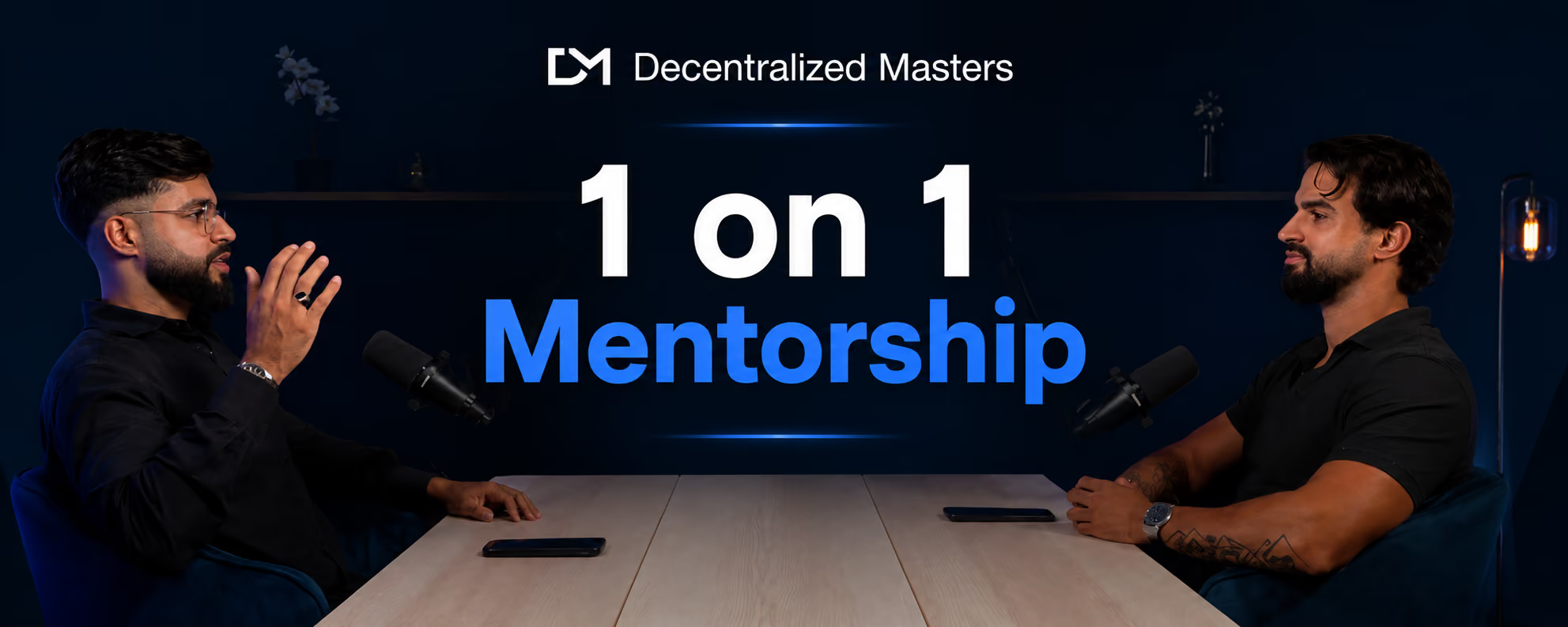
Best for: Investors who want mentorship spanning multiple asset classes rather than one.
Decentralized Masters is an investment education and research company covering macro, public equities, and digital assets.
It was co-founded by Tan Gera, ex-investment banker and CFA charterholder, and Salim Elhila, a mathematical engineer with a background in quantitative analysis and blockchain research. The model pairs a structured curriculum with one-on-one mentor guidance.
That combination is what earns the top placement.
Most investors learn in pieces. A stocks course here, a digital assets newsletter there, macro commentary from somewhere else. Each is fine on its own. But none of them knows what the others told you, and none has seen what you actually hold.
Decentralized Masters closes that gap by giving every member a dedicated mentor. These are working practitioners with verifiable records in the markets they teach, not content creators teaching from theory. Your mentor sees the whole portfolio, so they can tell you how your holdings work together rather than whether one of them looks good on its own.
What earns the top spot is narrower than being best at everything. It is the only option here that covers multiple asset classes and gives you individual attention at the same time.
Some cover several asset classes but never look at your portfolio. Others look at your portfolio but cover only one asset class. If you hold more than one kind of asset, and most investors do, that combination is the thing that matters most.
Limitations: the program is premium-priced and assumes you already have capital deployed. An investor starting from 0 should build a base first.
The free Sovereign Collective community covers the groundwork, and the Gems Uncovered newsletters add ongoing research at a much lower price.
Mentorship is worth its cost later, once you have live positions and real decisions to review.
Wharton Applied Value Investing Certificate
Best for: investors who want academic rigour and a credential.
Delivered by Wharton Online in collaboration with Wall Street Prep, this certificate teaches a framework for identifying undervalued equities, with instruction from Wharton faculty and practising investors.
It is open to individual investors, advisors, and institutions.
Against our criteria, it scores highest on curriculum structure and mentor credentials, and lowest on the two that define mentorship. The teaching is sequenced, and the faculty are verifiable, which puts it ahead of most providers on method.
What it does not offer is anyone tracking your portfolio. You finish with a framework for valuing a business and no relationship with a person who will ask what you did with it.
That makes it a strong complement rather than a substitute.
An investor who takes this first and arranges individual mentorship afterwards gets a better result than one who does either alone, because the certificate supplies the analytical vocabulary that makes mentor time efficient. Turning up to a paid 1-on-1 session without a valuation method is an expensive way to acquire one.
Worth being clear about what the credential does. It signals effort and completion to an employer or client. It does not signal investment skill, and no certificate does.
Limitations: a time-boxed certificate rather than an ongoing relationship, and equities only. Nothing on macro conditions, private markets, or digital assets, so it teaches one silo well and leaves the connective work to you. Excellent for method, not for accountability.
Value Investing Mentorship (VIM)
Best for: equity investors who want sustained small-group contact.
VIM runs over 12 months across 18 meetings in groups of six, combining skills instruction with analysis of live positions. The 12-month span is longer than most alternatives, and small groups mean you are visible rather than anonymous.
The design deserves attention because it addresses a problem most programs ignore. Investing decisions play out over quarters and years, so a 12-week course cannot show you whether your reasoning was sound, only whether you understood the lesson.
Running 18 meetings across a full year means your positions have time to resolve while someone is still watching, which is the only way a mentor can distinguish a good decision from a lucky one.
Group size does real work too. 6 people is small enough that the facilitator knows your holdings, and large enough that you watch 5 other investors reason through problems differently, which is often where the learning actually happens. Anonymous cohorts of several hundred offer neither.
The trade-off is structural and worth stating plainly. Shared time means your specific situation gets a fraction of each session rather than all of it, and the agenda belongs to the group.
Limitations: small group rather than true 1-on-1, and equity-focused. If your portfolio spans asset classes, the discussion will only ever cover part of it.
MentorCruise

Best for: investors who want to choose a specific individual.
MentorCruise operates a filterable directory of investing mentors working 1-on-1 by arrangement. You select the person, set the cadence, and pay for their time directly. Maximum flexibility, and the only option here where you fully control the match.
The marketplace model has an advantage the structured programs cannot match. If your need is narrow, say you hold a concentrated position in one sector and want someone who has actually run that book, you can search for that person rather than accept whoever a program assigns.
You can also start small, book a single session, and stop if the fit is wrong, which is not possible with a provider charging for a full term upfront.
That flexibility is also the weakness, because it inverts the burden of quality control.
A structured program has screened its mentors and sequenced what they teach. Here both jobs transfer to you, and the criteria in this guide become a checklist you apply yourself rather than one the provider has already passed.
Ask for a verifiable professional record rather than performance screenshots, and treat reluctance to provide one as the answer.
Best used by investors who already know what they need to learn. If you cannot yet name the gap, a directory of specialists is difficult to search usefully.
Limitations: no curriculum and no quality floor. Outcomes depend entirely on the individual you pick, and vetting is your job.
SMB Capital
Best for: those committed to short-term trading rather than investing.
SMB Capital runs a 6-month structured curriculum with mandatory journal-based trade review and a route toward proprietary trading. The trade review requirement is genuinely rigorous and rare.
The journal requirement is worth explaining, because it is the mechanism most investing programs lack. Writing down your reasoning before a trade and reviewing it against the outcome afterwards separates process from result, which is the only reliable way to tell whether you were right or merely fortunate. Making it mandatory rather than optional is the difference between a technique that exists in the material and one that actually happens.
Both features would improve a long-term investing program. Neither is available in one here, because the horizon is wrong. Reviewing dozens of intraday decisions a week trains a temperament built for action, and long-term investing mostly requires the opposite.
Limitations: this is trading education, not investing education. Wrong horizon if you are building a long-term portfolio, and included here mainly so you can rule it out deliberately rather than stumble into it from a search result.
Bulls on Wall Street
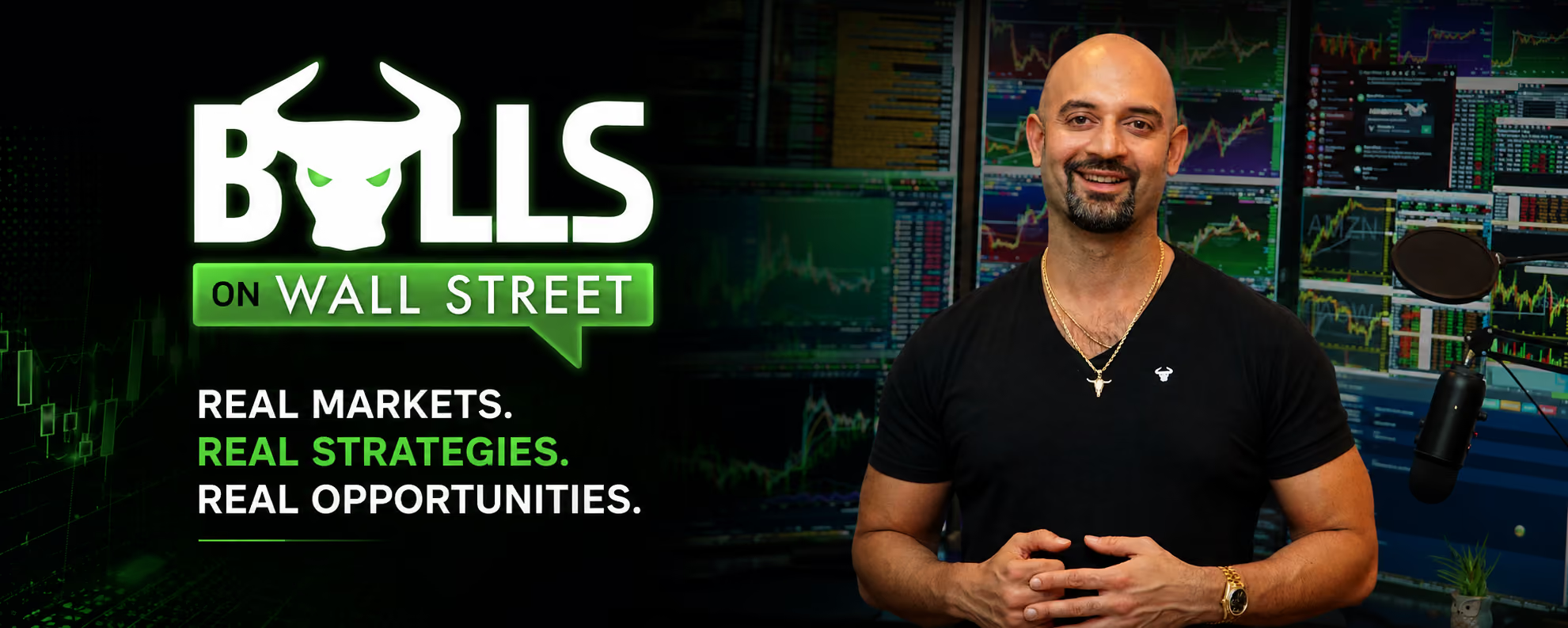
Best for: active traders wanting a defined bootcamp.
Founded in 2008 by Kunal Desai, Bulls on Wall Street runs a 60-Day Trading Bootcamp that includes 1-on-1 meetings with students.
Including individual meetings inside a bootcamp is unusual and worth crediting, since most short programs at this level deliver group webinars and call the result mentorship. The 60-day structure also sets a clear expectation. You know what you are buying, when it ends, and what you should be able to do by then, which compares well against open-ended memberships that bill monthly without a defined finish.
The firm has operated since 2008, which means it has traded through several distinct market regimes. Longevity is not the same as quality, but in a category where providers appear during bull markets and disappear afterwards, it is a reasonable filter to apply.
The horizon problem applies here as it does to SMB Capital. 60 days is long enough to learn an execution process and far too short to observe whether an allocation decision was correct. A bootcamp graduate finishes with skills for a different activity than the one this guide addresses.
Limitations: short-term trading focus, and the bootcamp format ends by design. Nothing keeps anyone accountable for your progress after the final day.
What an investment mentorship program should cost
Price ranges widely, and the reason is structural: mentor time is the expensive input. A content library scales infinitely, so it is cheap. An experienced person reviewing your portfolio for an hour does not scale at all, so it is not.
That gives you a useful test.
If a program promises extensive one-on-one access at content-library pricing, something has to give, and it is usually the definition of one-on-one. Conversely, price alone guarantees nothing. The best investment mentorship program for you is the one whose criteria match your situation, not the one with the highest fee.
Ask directly: how many hours of individual contact, with whom, over what period. Any credible provider will answer.
Frequently asked questions
What is an investment mentorship program?
A structured relationship in which an experienced investor guides your development over time, typically combining a curriculum with recurring one-on-one sessions reviewing your actual decisions.
Is an investment mentorship program worth it?
It depends on what you need. If you lack foundational knowledge, a course is cheaper and sufficient. Mentorship earns its cost when you are already active, making real decisions, and need someone to catch the errors you cannot see yourself.
What is the difference between an investment mentor and a financial advisor?
An advisor makes decisions on your behalf and manages your capital. A mentor teaches you to make your own decisions. Advisors are regulated to give advice; educators do not provide personal recommendations. Choosing between them is really choosing whether you want capability or convenience.
How much does an investment mentorship program cost?
Anywhere from a few hundred dollars for group programs to five figures for extensive individual access. Cost tracks the amount of real mentor time included.
Can a beginner join an investment mentorship program?
Some accept beginners, but most beginners get better value from foundational education first. Mentorship works best when you have decisions to review.
What should an investment mentorship program cover?
At minimum: how to research an opportunity, how to size a position, how asset classes behave in different macro conditions, and how to manage risk across a whole portfolio rather than one holding.
Educational content only. Nothing here is financial advice or a personal recommendation. All investing carries risk, including loss of capital. Do your own research and consider consulting a licensed professional about your circumstances.
Sources